

Annapurna Region, Nepal
Annapurna Circuit Trek
A journey through Manang, across Thorong La and into the rain-shadow landscapes beyond the Annapurna range.
Across the valleys and high passes of the Annapurna region
The Annapurna Circuit is a journey of transition — from the forested Marsyangdi valley into the open mountain country of Manang, towards Tilicho Lake and eventually the high crossing of Thorong La.
The trail changes gradually with altitude. Forest and cultivated valley give way to the drier country around Pisang and Manang, while the route towards Tilicho moves into increasingly exposed alpine terrain.
The rhythm is deliberate. Time in Manang, shorter acclimatisation stages and progressively higher nights prepare the body for Thorong La at 5,416 metres rather than treating the pass as a single objective.
Beyond the pass, the mountains open towards Mustang and the descent to Muktinath. Roads, teahouses and changing trail conditions are now part of the Annapurna Circuit, but the strongest sections still carry the feeling of travelling through the mountains on foot.
Journey
- Duration
- 11 Trek Days / 15 Days Total
- Highest Point
- Thorong La · 5,416m
- Max Sleeping Elevation
- Thorong High Camp · 4,800m
- Trek Begins
- Chame · 2,710m
- Trek Ends
- Muktinath
Best Seasons
On the Trail
- Difficulty
- Moderate to Strenuous
- Typical Walking
- Around 4–6 hours
- Accommodation
- Teahouses
- Fitness
- Active hiking fitness recommended
Logistics
- Permit
- Annapurna Conservation Area Permit
- Trail Team
- Licensed Guide + Trek Assist
- Cellular Connectivity
- 4G to Manang; coverage extends towards Tilicho Base Camp but may not always be available
- Internet / Charging
- Available
Tilicho Lake at 4,919m
A demanding journey away from the main circuit into exposed alpine country beneath Tilicho and Khangsar peaks.
Thorong La at 5,416m
The highest point of the journey, reached after several progressively higher nights before descending towards Muktinath and Mustang.
A deliberate pause in Manang
An acclimatisation day slows the journey before the route turns towards Tilicho and the first nights above 4,000 metres.
Through the Manang Valley
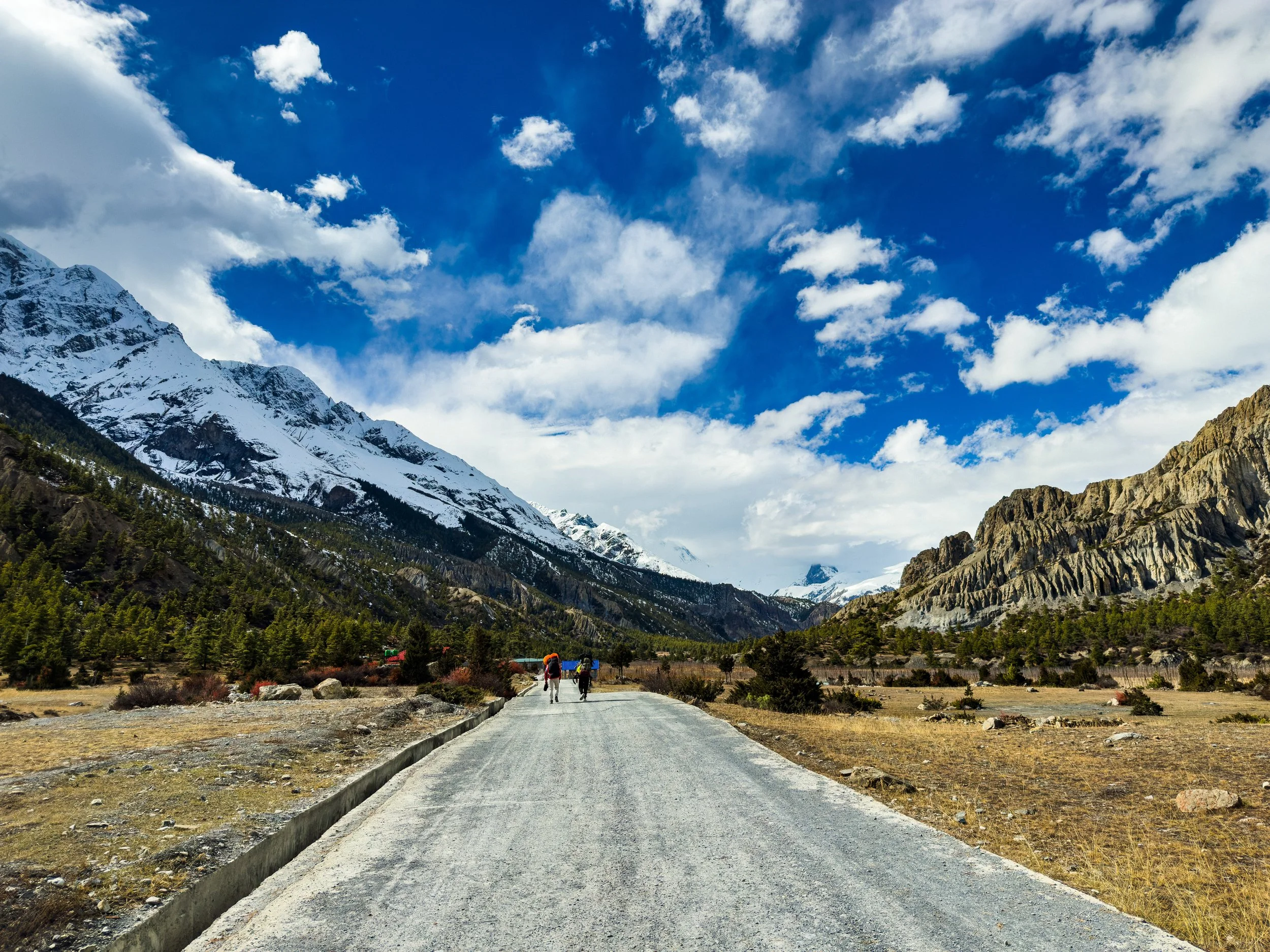
From Upper Pisang, the trail passes Green Lake and Humde before reaching Manang, where the valley broadens and the higher Annapurna landscape begins to define the journey.
Detailed Itinerary
From the valleys of Manang to Tilicho Lake and across Thorong La
The journey begins in Kathmandu before moving into the Marsyangdi Valley and steadily gaining elevation through Upper Pisang and Manang. From there, we leave the main circuit for Tilicho Lake before returning towards Thorong La and crossing into the valley of Mustang.
Day 01
Arrival in Kathmandu
Arrival in Kathmandu
Your Trekking Guide or a member of our team will receive you at Kathmandu International Airport. An airport transfer vehicle will be waiting to take us to your hotel. We recommend making use of the airport WiFi after arrival so that we can coordinate easily. The team member meeting you will be carrying a Darchog Adventures banner.
Once you are settled in, the rest of the day is yours. You can wander through the lively streets of Thamel, find a quiet place for a meal, or simply catch up on some much needed rest after the long journey to Nepal.
We will meet the following day for the pre trek briefing, equipment check and final preparations before leaving for the mountains.
For now, there is nothing you need to rush into. Kathmandu has a way of arriving all at once with its traffic, incense, temple bells, narrow streets, people, colours and constant movement.
Your first day is simply a chance to take in a little of that magnificent chaos and begin settling into Nepal before the journey into the Annapurna region begins.
Day 02
Trek Preparation and Exploration of Kathmandu
Trek Preparation and Exploration of Kathmandu
We will meet for our pre trek briefing and go through the journey ahead together. This is where we discuss the itinerary, trail conditions, weather, altitude, accommodation and anything else you would like to clarify before we leave Kathmandu.
We will also go through your trekking equipment and packing list. If anything is still missing, we can walk through Thamel and help you purchase or rent the necessary items.
We will collect the required documents for the Annapurna Conservation Area Permit and complete the final preparations for the journey.
Once everything is in place, the remainder of the day is yours to explore Kathmandu, rest and prepare for our early departure the following morning.
Day 03
Kathmandu to Besisahar onto Chame
Kathmandu to Besisahar onto Chame
Today we leave Kathmandu behind and begin the long road journey into the Annapurna region.
We depart early at around 5 am and travel towards Besisahar. Breakfast and several short breaks are made along the way, with the aim of reaching Besisahar between approximately 1 and 2 pm.
Besisahar is the district headquarters of Lamjung and the last large town before we travel deeper into the mountains. It is a useful final stop for additional supplies or cash before continuing.
After lunch we continue towards Chame and enter the Annapurna Conservation Area from Khudi. The road soon becomes rougher as we pass through Syange, Ram Bazar, Jagat and Dharapani.
Once we reach Chame, we settle into our teahouse, have dinner and rest. The journey on foot begins tomorrow.
Day 04
Chame to Upper Pisang
Chame to Upper Pisang
Our first full day on foot takes us from the forests around Chame towards the wider landscapes of Upper Pisang.
We begin after breakfast and follow the trail towards Dhukurpokhari. Along the way we pass Bhratang, home to a large apple farm and one of our favourite places to pause for coffee and apple pie.
We continue to Dhukurpokhari for lunch before hiking for approximately another 45 minutes to Upper Pisang.
After settling into the teahouse, the remainder of the afternoon is free to rest, explore the village and enjoy the surrounding views of the Annapurna range.
Day 05
Upper Pisang to Manang
Upper Pisang to Manang
We continue through the Manang Valley towards Manang. Along the way we pass Green Lake, a small alpine lake whose green waters sit beneath the surrounding Annapurna mountains.
Depending on conditions and preference, we can use the lower or upper trail. The lower route takes us through Humde, where we can stop for tea or coffee, before continuing towards Mungji for lunch.
From Mungji it takes approximately another 45 minutes to reach Manang. We aim to arrive during the early afternoon, leaving enough time to settle in and explore the village.
Manang has small cafés, local eateries, laundry facilities and the Himalayan Rescue Association clinic, making it an important place on the circuit before we move higher.
Day 06
Acclimatization Day in Manang
Acclimatization Day in Manang
Today is intentionally slow. The purpose is not to cover distance, but to give our bodies time to adapt before we move above 4,000 metres.
After a later breakfast, we hike towards Gangapurna Glacial Lake and Chongkar View Point at around 3,800 metres.
The short ascent gives us additional exposure to higher elevation while allowing us to return to Manang for the night.
After returning to the teahouse, the remainder of the day is reserved for rest and recovery. In the evening, we may take a gentle walk through the village to visit its stupa and old monastery.
Day 07
Manang to Shrikharka
Manang to Shrikharka
This is our first night above 4,000 metres, so the short distance is as important as the destination itself.
We leave Manang and follow the shared jeep road towards Khangsar for the first section of the day. The village has several teahouses where we can stop for refreshments.
Beyond Khangsar, the trail gradually climbs towards Tare Monastery before becoming steeper on the final approach to Shrikharka.
Once we arrive, we focus on hydration, food and rest while paying close attention to how everyone is adapting to the increase in elevation.
Day 08
Shrikharka to Tilicho Base Camp
Shrikharka to Tilicho Base Camp
The trail is short today, but the terrain demands our attention.
We leave Shrikharka and make our way towards Tilicho Base Camp, crossing the well known landslide section on the approach.
The landscape here becomes stark and exposed, shaped by wind, erosion and loose rock. We move carefully through this section and expect to reach the base camp after approximately three to four hours.
The short day gives us plenty of time to rest before the early morning climb to Tilicho Lake.
Day 09
Tilicho Lake and Return to Shrikharka
Tilicho Lake and Return to Shrikharka
This is likely to feel like one of the most demanding days of the entire Annapurna Circuit.
We wake at around 3:30 am, have a light breakfast and aim to begin walking at approximately 4 am.
The 5 km ascent from Tilicho Base Camp to Tilicho Lake takes around three to four hours and gains approximately 739 metres. Particular care is required around the landslide section because of loose rock and falling debris.
Tilicho Lake lies at 4,919 metres beneath Tilicho Peak and the Khangsar range. After spending some time at the lake, we begin our descent back towards Tilicho Base Camp.
We stop at the base camp for food and recovery before continuing the second half of the day back towards Shrikharka. This final section is approximately 6 km and normally takes around three hours.
Day 10
Shrikharka to Ledar
Shrikharka to Ledar
We leave Shrikharka and begin making our way back towards the main circuit, eventually joining the route towards Yak Kharka and Ledar.
The trail takes us through Upper Khangsar and past a large fenced alpine meadow used by local villagers for their yaks and cattle during winter.
From here we descend towards Ghunsang, where we can stop for tea, before continuing to Yak Kharka for lunch.
The final section climbs towards Ledar at approximately 4,200 metres, with views towards Khangsar Peak, Gangapurna and the Annapurna range.
Day 11
Ledar to Thorong High Camp
Ledar to Thorong High Camp
We are now close to the pass, but the altitude means there is no reason to rush.
After breakfast we begin climbing towards Thorong Base Camp at approximately 4,600 metres.
The distance is relatively short, but the increasing elevation makes the journey progressively more demanding. We stop at Thorong Base Camp for lunch and rest before continuing towards High Camp at around 4,800 metres.
After settling in, we avoid prolonged naps and instead spend some time outside. A short walk towards the High Camp viewpoint gives us further exposure to the altitude while offering views towards Annapurna, Gangapurna and the Chulu peaks.
We have an early dinner and hold our final briefing for Thorong La. We assess how everyone is feeling, discuss the conditions and make the final decision for the following morning before taking an early night.
Day 12
Thorong La to Muktinath and Tatopani
Thorong La to Muktinath and Tatopani
Thorong La is the culmination of the high mountain section of our journey.
We wake at around 3 to 3:30 am and prepare for the crossing. After a quick breakfast or hot drink, we aim to leave High Camp no later than around 4 am.
The first section gains much of the remaining elevation. Beyond the first teashop, the ascent becomes more gradual as we continue towards the pass.
Our aim is to reach Thorong La at 5,416 metres at around 7 to 7:30 am. After taking some time at the pass, we begin the long descent towards the western side of the mountains.
Depending on seasonal road access, the vehicle may be available closer to the lower Thorong area or we may need to continue walking towards Muktinath before joining our jeep.
From there we drive onward to Tatopani. After settling into the teahouse, the natural hot springs give us a well earned place to rest after completing the highest stage of the journey.
Day 13
Tatopani to Pokhara
Tatopani to Pokhara
After breakfast we leave Tatopani and begin the road journey towards Pokhara, which normally takes around four hours.
Along the way we pass through Kushma before continuing towards the Pokhara Valley.
The jeep takes us directly to our hotel. The evening gives us time to rest, reflect on the journey and say farewell to the trekking team after our days together in the mountains.
Day 14
Pokhara to Kathmandu
Pokhara to Kathmandu
The tourist bus departs Pokhara in the morning for the return journey to Kathmandu.
The drive follows Nepal's mid hill highways and normally takes approximately six to seven hours depending on road and traffic conditions.
After arriving in Kathmandu, a transfer takes you back to your hotel.
If you would prefer to spend additional time in Pokhara, we can instead arrange the accommodation and onward travel around your extended stay.
Day 15
Departure from Kathmandu
Departure from Kathmandu
At the appropriate time, our airport transfer vehicle will collect you from the hotel and take you to Kathmandu International Airport for your onward journey.
This brings our Annapurna Circuit journey together to an end. We bid farewell for now and hope the mountains have given you something worth carrying home with you.
Would you like to adjust the journey?
The itinerary above is the route and pace we recommend for the Annapurna Circuit. If you would prefer an additional rest day, a gentler pace, or a private departure, we can adjust the journey around your available time, acclimatization needs and the conditions on the trail.
USD 950
Per person
Our Annapurna Circuit Trek is priced around the core trekking services we manage, while meals during the trek remain separate. This keeps these variable costs transparent and gives you greater flexibility while travelling through the Annapurna region.
What's Included
- Overland Transfers
- Planned Private Jeep transfers outlined in the Trek itinerary and Tourist Bus Transfer from Pokhara to Kathmandu
- Airport Transfers
- Arrival and departure airport transfers in Kathmandu as specified in the itinerary.
- Trekking Team
- One licensed trekking guide accompanies the group, with one Trek Assist / Porter shared between two trekkers. Food, accommodation, transportation and insurance for the trekking staff are included.
- Trekking Permits
- Annapurna Conservation Area Permit (ACAP)
- Accommodation & Breakfast
- 3 nights in Kathmandu and 1 night in Pokhara, with Breakfast included.
- Tea House Accommodation During the Trek
- Tea house and lodge accommodation during the trekking portion on a twin sharing basis.
- First Aid & Duffle Bag
- A comprehensive first aid kit is carried by the Trek Guide, and a large duffle bag is provided for your main trekking luggage.
What's Not Included
- Meals During the Trek
- Breakfast, lunch and dinner during the trekking portion are paid separately.
- Tourist Visa for Nepal & Travel and Trek Insurance
- The cost of your Nepal tourist visa and appropriate travel and trek insurance are not included in the trip cost.
- Rescue, Recovery or Repatriation Expenses
- Should an emergency require rescue, recovery or repatriation, we will coordinate the response and provide the operational assistance required, using the resources available to us. The financial cost of these services is not included in the trek price and should be covered by your travel and trek insurance.
- Additional Costs From Trip Extensions
- Additional accommodation, meals, transport, trekking staff costs or other expenses resulting from itinerary extensions due to health, weather or personal preference.
- Other Personal Expenses
- Personal purchases and services not specifically listed under What's Included.
- Tips and Remuneration for Trekking Staff
- Tips and additional remuneration for your trekking team are not included in the trip cost.

Choose how you would like to travel
Private Trek
Travel on dates that suit you, with your own group and a journey arranged around your pace, plans and the way you would like to experience the Annapurna Circuit.
Join a Fixed Departure
Join one of our scheduled small-group Annapurna Circuit departures on selected dates.
- 08 Oct – 23 Oct 2026 5 places available
- 22 Oct – 06 Nov 2026 5 places available
- 23 Nov – 08 Dec 2026 5 places available · Guaranteed departure
What we look at when deciding whether this journey is a good fit
The difficulty of the Annapurna Circuit with Tilicho Lake comes less from technical terrain and more from consecutive walking days, altitude and the demands of moving through the higher mountains. These are the main things we look at when discussing whether this particular itinerary is a realistic fit for you.
Endurance
You are comfortable walking for several hours at a steady pace and can return to the trail the following morning without needing prolonged recovery. You do not need exceptional speed or athletic ability; consistent endurance over several consecutive days matters much more.
Long hikes currently leave you exhausted for more than a day, or you have little experience walking on consecutive days. This does not necessarily rule the trek out, but we would want to understand your current activity level and whether additional preparation or a gentler pace would be appropriate.
Altitude & Acclimatization
You understand that the pace becomes deliberately slower as we move higher and are comfortable allowing your body time to acclimatize. You are also willing to communicate changes in sleep, appetite, headache, fatigue or how you are generally feeling rather than trying to keep up with someone else.
You have previously struggled significantly at altitude, have a relevant medical concern, or assume that high physical fitness will protect you from altitude illness. Fitness helps with the work of trekking, but it does not tell us how your body will respond above 4,000 or 5,000 metres.
Trail Confidence
You are reasonably confident walking on uneven mountain paths and can slow down when footing becomes loose or the trail more exposed. The approach to Tilicho Base Camp includes landslide terrain where balance, attention and careful movement are more important than speed.
Loose ground, narrow paths or exposure cause considerable anxiety, or you have difficulty maintaining balance on irregular terrain. There is no technical climbing on the route, but the Tilicho section deserves to be understood properly before deciding whether you will be comfortable there.
Knees, Joints & Mobility
You can manage sustained uphill and downhill walking without recurring pain or significant mobility problems. Some preparation focused on the knees, ankles, hips and general leg strength is particularly useful because the trek includes substantial descents as well as climbs.
You already experience persistent knee, ankle or hip pain, particularly while descending, or previous injuries affect your movement on uneven terrain. The descent from Thorong La is long, and after several days of trekking it can place considerably more strain on the legs than many people expect.
Mountain Living
You are comfortable staying in mountain teahouses and understand that facilities change as we gain elevation. Accommodation along much of the Annapurna Circuit is relatively comfortable, but higher places such as Tilicho Base Camp and Thorong High Camp are simpler, colder and more functional.
Reliable private bathrooms, consistently heated rooms or hotel-level facilities are important requirements for you. We can explain exactly what to expect, but some flexibility with comfort is an unavoidable part of spending several days in the higher mountains.

Somewhere along the trail, the pace changes. You stop measuring the day by distance and begin noticing where you are.
Go deeper into the Annapurna Circuit
Some questions only become useful once you understand the journey itself. These guides take a closer look at the trail, conditions, preparation, costs and practical decisions we usually discuss with trekkers before setting out.
Annapurna Circuit Trek Overview
The Annapurna Circuit changes considerably as you move through it. Our route begins from Chame, continues through Upper Pisang and Manang, leaves the main circuit for Tilicho Lake, then rejoins the trail toward Thorong La at 5,416 metres before descending to Muktinath. The important part is not simply where the route goes, but how those days are paced around altitude, recovery and the more demanding sections of the trail.
Explore the complete trek guideDifficulty, Trail Conditions & Safety
The Annapurna Circuit is not difficult because of technical climbing. The challenge builds through consecutive walking days, altitude and changing terrain. On our Tilicho route, particular attention is needed through the exposed landslide sections beyond Shrikharka, while the ascent to Tilicho Lake and the long crossing of Thorong La demand endurance and careful pacing. We manage these days through acclimatization, early starts, regular assessment and the willingness to change plans when conditions require it.
Understand the difficulty and trail conditionsBest Time & Packing List
The best time to trek the Annapurna Circuit is also a packing question. Conditions can change considerably between the warmer lower valleys and the high alpine environment around Tilicho and Thorong La, while late-autumn, winter and early-spring departures may require additional cold-weather equipment. We plan clothing around layers rather than one heavy system, and make final decisions on sleeping bags, microspikes and other seasonal equipment closer to departure.
Plan what to bring and when to trekInternet, Charging & Connectivity
The Annapurna Circuit is connected, but not continuously. Wi-Fi is available at many teahouses and mobile coverage is useful through much of the route, including Manang, while connections become less predictable as we move higher. Charging is widely available as well, but electricity and individual sockets should never be treated as guaranteed. A small power bank is usually more useful than carrying a very heavy battery system.
Read our connectivity guideAnnapurna Circuit Trek Cost
The cost of an Annapurna Circuit trek is shaped by much more than the number of trekking days. Transport to and from the trail, guiding and porter support, accommodation, meals, permits and how much of the journey is organised privately all affect the final figure. We prefer to show what is actually being paid for, what remains variable on the trail and where apparently cheaper itineraries may simply be removing services rather than reducing the real cost of travelling.
Understand the cost of the trekGetting There & Trail Access
Reaching the Annapurna Circuit is part of the journey. For this itinerary we travel overland from Kathmandu to Besisahar before continuing by 4WD into the mountains toward Chame, where our walking route begins. Road access now reaches much further into the Annapurna region than it once did, but travel times and usable roadheads remain affected by road condition, season and local traffic. On the western side, our route continues by road after crossing Thorong La and reaching Muktinath.
Understand the route to the trailAnnapurna Circuit Trek FAQs
These are the practical questions that tend to come up once the route, itinerary and cost are understood. Some have simple answers. Others depend on the person, the season or the conditions we find on the trail.
Preparation & Altitude
How fit do I need to be for the Annapurna Circuit Trek?
You do not need to be a mountaineer or an endurance athlete, but you should arrive with a reasonable cardiovascular base and be comfortable walking for several hours on consecutive days.
Our route includes repeated ascent and descent, the side journey to Tilicho Lake, nights above 4,000 metres and the crossing of Thorong La at 5,416 metres. What matters most is sustained endurance rather than speed. Regular hiking, stairs, cycling, running or similar aerobic exercise helps considerably, particularly when combined with work on knee, hip and ankle strength and mobility.
Previous multi-day hiking experience is useful, but it is not a requirement if you prepare properly. Fitness helps with the workload; it does not determine how well you acclimatize.
Do I need previous high-altitude trekking experience?
No. Previous high-altitude experience is useful because you may already understand how your body tends to respond, but it is not required for this itinerary.
We are more interested in whether you can walk comfortably for consecutive days, communicate clearly about how you are feeling, and accept that the pace may become slower as we move higher.
Altitude affects people differently, including very fit trekkers. We therefore build the journey around gradual ascent, acclimatization, recovery, hydration and regular assessment rather than assuming fitness will protect someone from altitude illness.
Is Ice Lake part of the acclimatization day in Manang?
Not automatically. Ice Lake is a worthwhile side trip, but it also involves roughly another thousand metres of ascent above Manang and can become a substantial trekking day in itself.
There is an important difference between acclimatization and recovery. Sometimes gaining additional altitude and returning lower is useful; at other times the body benefits more from an easier day, good food, hydration and rest before moving toward Tilicho and eventually Thorong La.
We make that decision with the people we are actually trekking with rather than treating Ice Lake as a compulsory box to tick.
What happens if I start showing symptoms of altitude sickness?
We stop treating the itinerary as the priority.
A new headache, unusual fatigue, nausea, dizziness, poor appetite or another concerning change at altitude should be communicated to the guide rather than hidden in an attempt to keep moving.
Depending on the symptoms and how they develop, the response may involve rest, delaying further ascent, changing the following day's plan or descending. If symptoms worsen, descent takes precedence over completing Tilicho Lake, Thorong La or any other objective.
Read our approach to Mountain SafetyTrail & Itinerary
What happens if snow, weather or trail conditions affect Tilicho Lake or Thorong La?
The itinerary changes. Tilicho Lake and Thorong La are high-mountain objectives, and neither should be treated as guaranteed simply because they appear on a printed itinerary.
Snowfall, wind, trail condition, landslides, local information, individual health or other circumstances can change what is sensible on a particular day.
There is no single fixed Plan B. We assess what is happening, gather local information where relevant and decide whether it is better to wait, change the day's objective, alter the route or descend. Our responsibility is to make the best decision for the conditions we actually encounter.
Explore difficulty, trail conditions and safetyCan we change the pace or itinerary after the trek has started?
Yes, where the route, accommodation and logistics allow it.
Someone may benefit from another recovery day. A group may need to move more slowly at altitude. Weather may require us to wait. There may also be occasions when a minor route or timing adjustment simply makes the journey better.
We intentionally retain that flexibility because a mountain itinerary should guide the journey rather than control it. Additional days or major changes can create extra accommodation, food, transport or staffing costs, and we discuss those clearly before proceeding.
How much of the Annapurna Circuit is now on jeep roads?
Road construction has changed the Annapurna Circuit considerably, which is one reason the name now describes quite different itineraries.
Our journey does not pretend that every historical section of the original circuit is still desirable walking. We travel overland through Besisahar and continue by 4WD toward Chame, where our main trekking route begins.
Even from there, the walking trail occasionally meets or follows local road sections. We plan the route around the strongest trekking experience available rather than preserving older stages simply because they belonged to the historic circuit.
Read about getting there and trail accessFood, Water & Teahouses
Can you accommodate coeliac disease, gluten-free diets, food allergies, religious diets or other specific nutrition requirements?
Often, yes, but we want to discuss this with you before the trek, particularly when the requirement is medical or strict rather than simply a preference.
We have experience trekking with people who are gluten-free, including travellers with coeliac disease, as well as trekkers with religious dietary restrictions and people who wanted their meals adjusted around higher protein intake or other specific nutritional goals.
Meals are not included in our standard Annapurna trekking package. For ordinary preferences, we can usually help you navigate teahouse menus as we travel.
For coeliac disease, serious allergies, strict religious requirements or another diet where ingredients and preparation need closer management, we prefer to discuss the requirement beforehand and, where appropriate, create a meal-inclusive arrangement so that we can plan the journey accordingly.
Mountain teahouses are independently operated kitchens. We can communicate directly with cooks, identify appropriate ingredients and reduce avoidable risks, but we would not promise a medically absolute zero-risk environment for cross-contact.
Will I be able to refill drinking water regularly, and how much should I carry?
Yes. You do not need to carry an entire day's water from the beginning of every stage.
Water can be replenished during the journey, but gaps between convenient refill points vary. We therefore recommend carrying capacity for at least two litres while walking.
Through the day we generally aim for around 3–4 litres, adjusted for conditions and exertion, with bottles being replenished as we move rather than carrying everything at once.
Two 1-litre hard bottles work particularly well. A Nalgene-style bottle also has another useful role in the mountains: carefully fill it with hot water in the evening, make sure the lid is completely sealed, and it can provide extra warmth inside your sleeping bag.
Should I use purification tablets, a water filter or boiled water?
All can be workable approaches. The important principle is that water from an uncertain source should be appropriately treated rather than assuming clear-looking mountain water is automatically safe.
Purification tablets are lightweight and simple, but they need the correct treatment time. A personal filter provides another reusable option. Boiled water is available at many teahouses, although it normally comes at an additional cost and becomes more expensive higher on the route.
We generally recommend carrying a treatment method yourself rather than relying entirely on bottled water. It reduces plastic waste and means your hydration strategy is not dependent on a shop being available exactly when you need to refill.
What are the teahouse rooms, toilets and hot showers actually like?
Generally more comfortable than many first-time trekkers expect, but standards vary from village to village.
Along much of the route, teahouses provide simple private rooms with beds and blankets. Some have ensuite bathrooms, while others use shared toilets. Hot showers are available at many locations through the lower and middle sections, normally for an additional charge.
Comfort becomes more limited on the high section. Thorong High Camp in particular has far fewer accommodation options and should not be expected to provide the same facilities as Chame or Manang.
We describe the accommodation as basic, practical and generally comfortable, rather than luxury.
Do I need a sleeping bag for the Annapurna Circuit?
That depends considerably on the season.
Teahouses provide bedding and blankets, and during warmer trekking periods many people find the available bedding manageable with appropriate sleep clothing.
For colder departures, particularly from late autumn through winter and into early spring, we are much more likely to recommend carrying a suitable sleeping bag.
You do not necessarily need to buy one. Sleeping bags and other seasonal equipment can be rented in Kathmandu, and we review equipment before departure so you carry what the season actually requires rather than packing for every imaginable condition.
Explore our best-time and packing guidanceMoney & Practicalities
How much cash should I carry for the Annapurna Circuit Trek?
Carry enough for your pay-as-you-go mountain expenses plus a sensible reserve. Meals and teahouse accommodation on the trekking portion of our current Annapurna package are paid separately, so your personal cash requirement is more important than it would be on a fully inclusive itinerary.
Besisahar is the last major town with several ATM and banking options. There are ATMs in Chame and Manang as well, and they can be useful if needed, but we prefer to treat those as backups rather than building the trip around them. Machine availability, cash supply or network connectivity can change.
Chame and particularly Manang also have small shops where a few forgotten essentials can sometimes be replaced. They are useful mountain hubs, but specialist equipment and the majority of your trekking preparation should still be completed in Kathmandu.
We deliberately avoid publishing one permanent cash figure here. Food habits, personal spending and trail prices vary, while a fixed number can become outdated quickly.
Read our Annapurna Circuit cost and trail-budget guideWhat extra expenses should I expect on the trail?
Small day-to-day expenses are often what travellers forget to budget for.
Beyond meals and your room, personal costs may include hot showers, Wi-Fi, charging, boiled or hot drinking water, snacks, soft drinks, coffee, laundry, toilet paper and occasional supplies bought along the way.
Prices generally become less predictable as supplies travel further into the mountains. This is why we prefer to separate the fixed services we organise from variable trail spending, rather than hiding everything inside one headline figure.
Understand the real cost of the Annapurna CircuitIs tipping expected for guides and Trek Assists in Nepal?
A tip is appreciated when you genuinely feel the team contributed meaningfully to your journey, but we do not believe gratuities should be used to compensate for poor wages.
Our trekking staff are paid on the basis that their remuneration comes from the trek itself. We therefore prefer to describe tipping as a personal gesture of appreciation rather than a compulsory percentage or a hidden addition to the trip cost.
If you want guidance near the end of the trek, you can ask us openly. There should be no embarrassment, pressure or expectation around that conversation.
Safety & Support
What travel insurance do I need for the Annapurna Circuit Trek?
Your policy should explicitly cover high-altitude trekking to at least 5,416 metres , the elevation of Thorong La, together with emergency medical treatment and helicopter evacuation where applicable.
Do not assume ordinary travel insurance automatically includes trekking at this altitude. Check the activity and elevation limits in the policy wording before travelling.
Helicopter evacuation is also not instantaneous. Weather, flight clearance, aircraft availability and insurance coordination can all affect how quickly an evacuation takes place. This is one reason early recognition and conservative management of illness matter.
We support helicopter evacuation when there is a legitimate operational or medical need. It should never be treated as a convenient way to shorten the journey.
Read our Mountain Safety approachBefore you book
By this point, you probably understand the route, the cost and what the Annapurna Circuit asks of you. What remains is often more personal: whether to join a departure or travel privately, how a booking actually works, what happens if your plans change, or whether something about your own circumstances needs a proper conversation before you commit.
Private journey or fixed departure?
You do not have to wait for a scheduled group to trek the Annapurna Circuit with us.
We organise private departures on dates that work for you, whether you are travelling alone, as a couple, with friends or as a small group. We also publish selected fixed departures for travellers who would prefer to join others and share the journey.
A fixed departure can be a good option if your dates align and you enjoy travelling with a small group. A private trek gives us more freedom around your preferred dates, pace and overall trip arrangement.
View upcoming fixed departuresHow does booking work?
A booking does not begin with payment. It begins with a conversation.
You can send us an enquiry first, ask questions and tell us what you are considering. We review your dates, group size, experience and any particular requirements before confirming the final itinerary and trip arrangement.
Once everything is clear, we send your booking details and invoice. A 10% booking deposit confirms your place, with the remaining balance handled according to the booking terms provided with your trip.
You should know what you are agreeing to before money changes hands.
See how our booking process works
Is there something we should know about you?
There are questions that a trek page cannot answer properly.
You may have an old knee injury. You may be travelling with children or older family members. You might have never slept above 3,000 metres, have strict dietary requirements, need a slower pace, be managing a medical condition, or simply be uncertain whether one part of the itinerary is realistic for you.
Tell us. We would rather understand the situation before you book than give you a generic reassurance afterwards. Where something needs professional medical advice, we will tell you that rather than trying to make that judgement ourselves.
The purpose is not to find reasons you cannot trek. It is to understand how the journey should be approached.
Talk to us about your situationIf your plans change
Committing to a trek does not mean life suddenly becomes predictable.
Flights change. Leave gets moved. Injuries happen. Family circumstances change. Sometimes a travelling companion can no longer come.
Our booking terms explain the formal cancellation and refund conditions, but if something changes, the first thing to do is speak with us as early as possible. Depending on the timing and circumstances, postponing or adjusting a departure may sometimes be more practical than simply cancelling it.
We will explain clearly what can be changed, what costs have already been committed and what options remain.
Read our booking and cancellation terms
Know what you are committing to
The Annapurna Circuit is a teahouse trek, but it is still a high-altitude mountain journey.
You will walk for consecutive days, sleep progressively higher, travel through changing weather and eventually cross Thorong La at 5,416 metres. Tilicho Lake adds another demanding high-altitude objective to this itinerary.
There are comfortable villages, meals, Wi-Fi and mobile coverage along much of the route, but none of these should be understood as permanently guaranteed. Higher in the mountains, comfort and connectivity become less predictable.
You do not need to arrive as an athlete. You do need to arrive prepared for the fact that plans, pace and sometimes objectives may have to change.
That uncertainty is part of travelling in the mountains rather than a failure of the itinerary.
Revisit trek suitability and preparationWhat are conditions like now?
Mountain conditions change much faster than a trek page should. Before every departure we review available information about weather, snow, trail conditions, road access and any other development that could materially affect the journey. If you are travelling soon, ask us for the latest trail note for your departure rather than relying on an older itinerary or seasonal description.
Ask about current trail conditionsStill deciding?
You do not need to have everything figured out before contacting us. If you have a question about the trek, your own circumstances, available dates or something you have not found an answer to on this page, ask us.
I have a question
For something simple you would like to clarify before making any decision.
Start a conversationI want advice about my situation
Tell us about your experience, fitness, dates, dietary needs or another circumstance that deserves a more considered answer.
Tell us about your plansReady to begin?
If you already know the trek and dates you are interested in, send us the details and we can begin preparing your booking.
Send a booking requestStories from the Trail
Every journey leaves a different impression. These are words shared by travellers after walking through the Himalayas with Darchog Adventures.
"Deep into the trek he was truly tested as our group dealt with medical issues that he handled with the utmost confidence and grace."
Patrick Gietl
Kanchenjunga Circuit Trek
"Due to weather conditions, Kiran quickly rearranged everything and made sure we could continue our journey safely while still enjoying the trek."
Marvin Stüde
Annapurna Circuit Trek
"By the end of the trek not only did we feel accomplished, but we felt like we made a good friend."
Brad Martin
Annapurna Circuit Trek
"He was amazing with our kids and modified our trip as needed, making the journey comfortable and enjoyable for everyone."
Michelle Pedersen Meredith
Annapurna Base Camp Trek
More traveller experiences
These are only a few stories shared by travellers who have joined Darchog Adventures. Continue reading more experiences and recommendations directly on our Facebook page.
Continue reading traveller experiences
Every journey begins with a conversation.
If the Annapurna Circuit feels like the right journey for you, tell us what you are considering. Share your dates, who you are travelling with, and anything you would like us to understand before we begin planning. We can take it from there.
Prefer to talk with us?