
How does the Porter System work on a Trek in Nepal?
How Does the Porter System Work on a Trek in Nepal?
If you are trekking in Nepal for the first time, one of the things you may wonder about is what actually happens to your luggage once the trek begins.
You may have heard that a porter will carry your bags, but what does that really mean?
How much can a porter carry?
How is the luggage divided between trekkers?
What should you carry in your own daypack?
And perhaps more importantly, what is a fair load for someone who is carrying your belongings through the mountains?
The porter system is an important part of trekking in Nepal. It allows trekkers to travel lighter while creating employment for people from mountain communities. But the system works best when the weight is shared responsibly and the people carrying the luggage are treated fairly.
At Darchog Adventures, we use the term Trek Assist because their role goes beyond simply carrying a bag. They are part of the trekking team, helping with luggage, camp logistics and the day-to-day movement of the group.
Here is how the system generally works.
How Much Luggage Can You Take?
Our trekking luggage system is designed around a simple principle: keep the load reasonable for everyone involved.
| Your Luggage | What Happens |
|---|---|
| Up to 16 kg shared duffle | Carried by 1 Trek Assist for 2 trekkers |
| More than 16 kg | We can arrange an additional Trek Assist |
| Extra luggage you don't need on trek | We can store it securely in Kathmandu |
| Luggage you need after the trek | We can courier it to the city where your trek ends, such as Pokhara, so it is waiting for you when you arrive |
A Simple Rule
2 Trekkers → 1 Trek Assist → Maximum 16 kg shared duffle (≈ 8 kg per trekker)
If your luggage exceeds this, please don't try to make the Trek Assist carry more simply because there is space in the bag. There are better solutions:
- Need to take everything? → We can arrange an additional Trek Assist.
- Don't need some of your luggage during the trek? → We can store it in Kathmandu and you can collect it when you return.
- Need the luggage at your next destination? → Where practical, we can courier it to the city where your trek ends — for example, sending your luggage to Pokhara while you are trekking, so it is ready to meet you when you finish.
How Does the Trek Assist System Work?
For our treks, one Trek Assist is allocated to two trekkers.
The maximum recommended weight of the main duffle bag is 16 kg. In a two-person arrangement, this means approximately 8 kg of luggage allowance per trekker.
The idea is simple:
How Does the Trek Assist System Work?
2 Trekkers
1 Trek Assist (Porter-Guide Support)
1 Large Shared Duffle or 2 Medium Individual Duffles
Maximum Recommended Load: 16 kg
Balanced weight allocation ensuring ethical load carrying and comfortable trekking.
The duffle bag is provided by the trekking company and is used for the belongings that you do not need throughout the day. You can also alternatively provide them with your main Bag Pack, but please note that, the bag pack is tighly packed around with rope so we advise Duffle Bags.
The Trek Assist then carries the duffle bag along the trail, traditionally using a head strap or namlo system.
This is one of the reasons we recommend keeping the duffle as light as reasonably possible.
A Trek Assist is not simply carrying your 16 kg of luggage. They also have their own backpack and personal belongings to carry. Depending on the trek and their equipment, their overall load can therefore become considerably heavier.
That is why the 16 kg duffle limit should be treated as a practical consideration rather than a target to reach.
Less weight is always better.
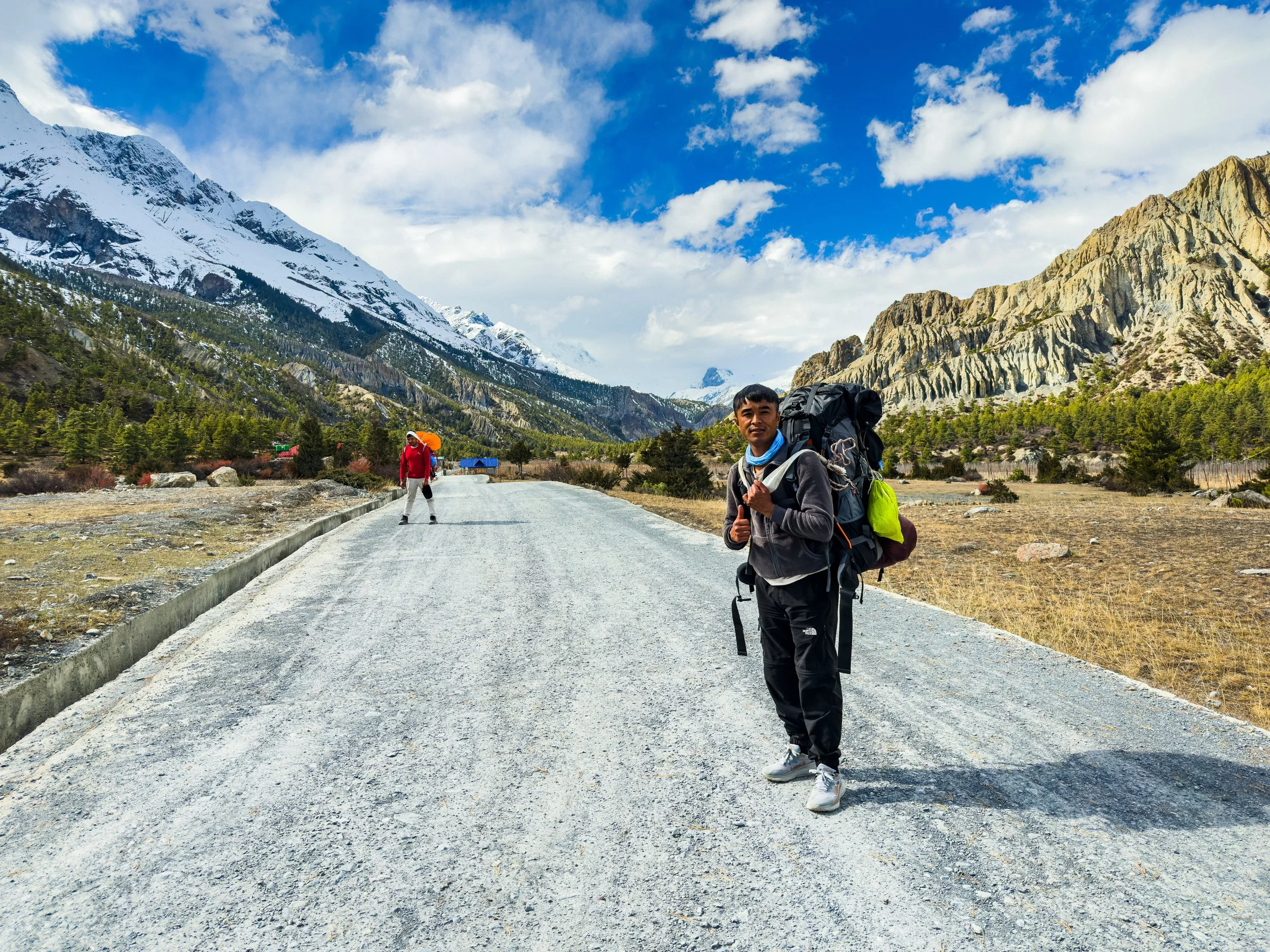
Our Lead Trek Assist Ram and Trek Assist Samir, enroute Manang on lower trail from Upper Pisang in Annapurna Circuit Trek. They use head straps (namlo) to carrry the luggage.
What Goes Into the Duffle Bag?
What Goes Where
Daypack
You Carry- Documents
- Cash & Valuables
- Water & Hydration
- Trail Snacks & Electronics
- Outer Shell Jacket
-
Beanie, Sun Hat, Buff & Sunglasses
-
Sun Cream, Hand Sanitizer, Toilet Paper & Wet Wipes
-
Prescription Medication (if any)
-
Mini First Aid (Blister Tapes, Band-Aids, Ibuprofen, Cetamol)
Duffle Bag
Trek Assist Carries- Extra Trek Clothing
- Spare Thermal Layers
- Sleeping Clothes & Camp Wear
- Personal Hygiene & Bulk Belongings
- Sleeping Bag
- Non-Essential Trail Items
Your duffle bag is for the things you will not need during the walking day.
This normally includes your main clothing, sleeping clothes, additional layers, spare footwear and other personal belongings.
You should avoid putting fragile or valuable items inside the duffle.
Remember that the bag is being transported over uneven mountain trails, often using a head strap. It may be placed on the ground, loaded onto vehicles, exposed to dust or rain and handled multiple times during the journey.
For that reason, keep your:
Camera and other fragile equipment
Passport and personal documents
Cash and valuables
Mobile phone
Electronics
Medication that you may need during the day
with you in your own daypack.
A good rule is simple:
If you cannot afford to lose it or damage it, do not put it in the duffle.
What Should You Carry in Your Daypack?
Your daypack contains the things you may need while walking.
You do not need to carry everything with you. In fact, one of the biggest advantages of using a Trek Assist is that you don't have to.
Your daypack should contain only what you may realistically need during the walking day.
1. Personal Documents and Extra Cash
Keep your passport, permits, insurance documents and some emergency cash with you.
It is better not to put important documents or large amounts of cash into your main luggage.
2. Water and Snacks
Carry your hydration bottle or water bladder along with some snacks.
Depending on the trek, you may also want quick sources of energy such as chocolate, nuts, energy bars or other snacks you are comfortable eating while walking.
3. Basic Toiletries
A few small personal items can make a big difference during the day:
Hand sanitizer
Toilet paper
Sunscreen
Lip balm
Personal medication
Any other small essentials
There is no need to carry your entire toiletry kit.
4. Sun Protection and Small Accessories
Keep your sunglasses, beanie or sun hat easily accessible. Mountain weather can change quickly, and you may want to add or remove these items without opening your main luggage.
5. An Extra Layer
An extra lightweight fleece or shell jacket is worth carrying.
You may start walking in comfortable conditions and find yourself in colder temperatures, wind or rain later in the day. A lightweight Gore-Tex shell or similar waterproof layer is particularly useful because it can remain in your daypack until you need it.
6. Electronics
Your phone, camera, Kindle, tablet and other electronics should remain with you if you are carrying them.
Don't forget the relevant charging cables, power banks or other small accessories you may need during the day.
How Heavy Should Your Daypack Be?
We recommend keeping your daypack below 5 kg whenever possible.
Five kilograms may not sound like much when you are walking around Kathmandu, but it feels very different when you are carrying it for several consecutive days at altitude.
You are already using your body to climb thousands of metres above sea level. Adding unnecessary weight to your shoulders can make the walking considerably more tiring.
The purpose of having a Trek Assist is not to move everything from your suitcase into your daypack.
It is the opposite.
Carry what you need. Let the Trek Assist carry what you don't.
A well-organized daypack should therefore contain your essentials, while the duffle contains the majority of your non-essential belongings.
What If You Have More Than 16 kg?
This is where planning before the trek becomes important. If two trekkers have more luggage than the allocated 16 kg duffle allowance, there are several options.
The first is to reduce the weight which is usually the simplest solution.
Mountain trekking does not require as many clothes or personal items as most people initially think. A carefully planned packing list can significantly reduce the amount of luggage you need. If additional luggage is genuinely necessary, we can arrange an additional Trek Assist.
Alternatively, extra luggage can often be stored securely in Kathmandu while you are on the trek.
For certain itineraries, we can also arrange for luggage to be transported separately to meet you later in the journey. For example, where appropriate, we can organize courier transport to Pokhara. Any such courier service would be calculated separately and added to the final cost.
The important thing is to communicate this before the trek rather than arriving at the trailhead with significantly more luggage than the team has planned for.
Why Does the Weight Matter?
This is perhaps the most important part of understanding the porter system. A porter or Trek Assist is working while carrying your belongings. t is easy to look at a 16 kg duffle and think:
"That's not particularly heavy."
But that is only the weight of the luggage. The Trek Assist may also be carrying their own clothing, sleeping equipment, food and other personal belongings. Their total load can therefore reach approximately 22–24 kg, depending on the circumstances and they are carrying that load while walking the same mountain trails as you.
Sometimes the trail is relatively easy and sometimes it is steep, rocky, muddy, exposed or covered in snow.
And at high altitude, every additional kilogram matters.
This is why we believe the conversation around porter welfare should not simply be about whether a particular weight is technically allowed. It should also be about whether that weight is reasonable.
Is There a Legal Weight Limit for Trekking Porters?
There is an important distinction here.
A specific legal weight limit does not necessarily govern every porter arrangement across every trekking route in Nepal. Companies and operators may therefore use different internal limits and practices.
For us, 16 kg is a practical maximum for the shared duffle arrangement, not a number that we encourage trekkers to automatically fill.
Our intention is to keep the overall load manageable while recognizing that the Trek Assist is also carrying their own belongings.
The simplest principle is:
A maximum should never become a target.
If you can reduce your luggage from 16 kg to 12 kg, that is better.
If you can reduce your daypack from 5 kg to 3 kg, that is better too.
The mountains do not reward unnecessary weight.
The Porter System Should Work for Everyone
Trekking is often described as an individual experience; your journey, your challenge, your adventure but very few treks in Nepal are actually individual journeys. There are guides, Trek Assists, cooks, drivers, accommodation staff and many other people who make the journey possible.
The people carrying your luggage are an especially visible part of that system. For us, fairness means looking beyond the question of "How much can they carry?"
The better question is:
"How much should they reasonably be asked to carry?"
This distinction matters. We believe Trek Assists should be compensated fairly for their work, given reasonable loads and treated as an important part of the trekking team rather than simply as a means of transporting luggage. That is also why we encourage trekkers to think carefully about what they pack.
A lighter bag is not only easier for you, it is easier for the person carrying it.
Our Approach at Darchog Adventures
We believe that trekking should be fair to everyone involved.
That means being transparent about what is included, being realistic about what our field team carries and encouraging our guests to pack responsibly.
Our Trek Assist system is based on one Trek Assist for two trekkers, with a maximum recommended 16 kg shared duffle.
We provide the duffle bag, help you understand what should go inside it and encourage you to keep both your main luggage and daypack as light as practical. If you have additional luggage, tell us beforehand.
We can then look at the appropriate solution, whether that means reducing the luggage, arranging an additional Trek Assist, storing belongings in Kathmandu or organizing separate transportation where possible. There is no reason for a porter to carry unnecessary weight simply because it was not discussed beforehand.
Trekking Should Be a Shared Responsibility
The porter system has been part of trekking in Nepal for generations, and it remains an important part of how many journeys through the mountains are possible. But the system works best when everyone understands their responsibility.
Pack light.
Carry what you need.
Respect the people carrying the rest.
For us, responsible trekking is not only about leaving the mountains clean or choosing the right trail. It is also about how we treat the people who help us travel through them. A lighter duffle may seem like a small thing. For someone carrying it over a mountain pass, it can make a very real difference.
Preparing for Your Trek
Understanding how the porter system works is one part of preparing for a trek. Knowing what to pack, what to leave behind, and how to keep your overall load comfortable is just as important.
Packing Guide for Himalayan Treks
A practical guide to packing lighter, smarter, and more comfortably for your trek—covering clothing, footwear, sleeping gear, and personal essentials.
Read the Packing GuideExplore Our Journeys
Find your next trek or expedition in Nepal, crafted with care across the Himalayas.
What Makes Us Different
Learn about our approach to people, fairness, and responsible trekking in Nepal.
