
Kanchenjunga Circuit Trek
Kanchenjunga Circuit Trek Overview
Often described as the last true wilderness adventure of the Himalayas, the Kanchenjunga Circuit Trek is a journey into the remote north-eastern corner of Nepal. Raw, isolated, and remarkably authentic, it is perhaps the closest experience to what trekking in the Everest or Annapurna regions was three decades ago. While many of Nepal's popular trekking destinations have gradually evolved into more commercial experiences, Kanchenjunga has retained its pristine landscapes and genuine mountain culture.
What continues to stand out to me, having led expeditions in this region over the years, is that the experience still feels untouched and never transactional. From the villages of Sekathum, Amjilosa, Gyabla, and Ghunsa, the journey unfolds gradually through dense forests, cardamom plantations, cascading rivers, and rustic mountain trails before revealing the dramatic alpine landscapes higher up the valley. There is a quietness to the region that is increasingly difficult to find elsewhere in the Himalayas.
The Kanchenjunga region is recognised as one of the world's 34 Biodiversity Hotspots, and it is easy to understand why. Its remarkable ecological diversity supports an extraordinary range of flora and fauna, including the elusive Red Pandaand the Snow Leopard, often referred to as the Queen of the Himalayas. Beginning at Sekathum (1,575 m) and gradually ascending to Pangpema (5,143 m), the Kanchenjunga North Base Camp, the trek passes through an astonishing range of ecosystems. Over the course of 15–16 days, trekkers witness the transition from lush subtropical forests to alpine tundra and glacial landscapes—one of the defining characteristics that makes this journey so unique.
It was the renowned botanist Sir Joseph Dalton Hooker, a close friend of Charles Darwin, whose pioneering work in the eastern Himalayas helped establish this region as one of the world's great centres of biodiversity. Dominating this landscape is Mount Kanchenjunga (8,586 m / 28,169 ft), the world's third-highest mountain and Nepal's second-highest peak after Mount Everest. Rising from its own isolated massif along the Nepal–India border, Kanchenjunga is far more than a mountain to the people who call this region home. For many local and indigenous communities, it remains a sacred mountain and one of the spiritual focal points of the Himalayas.
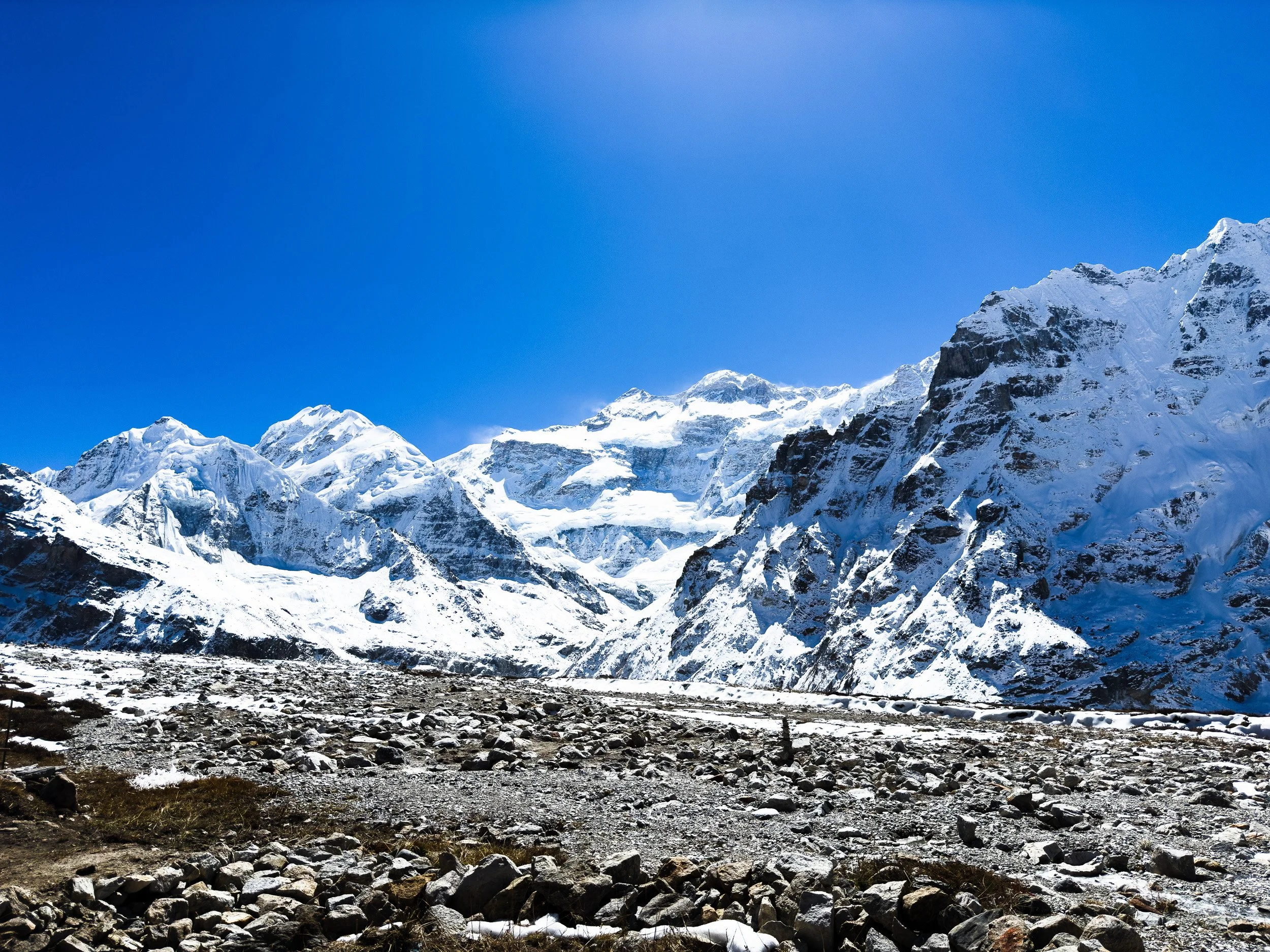
Kanchenjunga North Base Camp (Pangpema) with the main Kanchenjuga Peak on the center, Autumn 2025
Getting to the Kanchenjunga Region
As rewarding as the Kanchenjunga Circuit Trek is, reaching this remote corner of Nepal is an adventure in itself. Unlike many of Nepal's popular trekking regions, the journey requires 22–24 days, of which approximately four days are dedicated to travelling to and from the trailhead.
Our journey begins with a 45-minute flight from Kathmandu to Bhadrapur in eastern Nepal, followed by an 8–9 hour jeep drive to the town of Phungling (Taplejung). Rather than completing the drive in a single day, we often choose to break the journey with an overnight stay in Kanyam, Ilam. This not only makes the journey more comfortable but also offers the opportunity to experience one of eastern Nepal's hidden gems, renowned for its rolling tea gardens, cool climate, and locally produced artisanal cheese.
From Phungling, we continue with a scenic three-hour drive to Sekathum, the current trailhead of the Kanchenjunga Circuit Trek. The effort required simply to reach the starting point offers a glimpse of just how remote this region truly is.
Although a weekly Kathmandu–Taplejung flight operated by Nepal Airlines is available, it is often affected by changing mountain weather, making it a less reliable option for a fixed trekking schedule. In recent years, the ongoing Tamor Corridor Road Project and hydropower developments along the Tamor River have also altered the traditional approach to the trek, shifting the trailhead from Mithlung or Chiruwa further north to Sekathum.
The Route
The classic Kanchenjunga Circuit Trek begins by following the Ghunsa Valley northwards to Pangpema (5,143 m), the spectacular Kanchenjunga North Base Camp. After spending time beneath the immense north face of the mountain, we retrace our steps to Ghunsa before ascending towards Selele High Camp.
From here, the character of the trek changes dramatically as we cross the Selele La, Mirgin La, and Sinion La (Sine Lapcha) passes to reach the southern side of the Kanchenjunga massif and descend into the valley of Tseram.
On a clear day, the views from Selele High Camp and Selele La are truly exceptional. Looking west across the Himalayan skyline, it is often possible to see Mount Everest and Mount Makalu rising in the far distance—a perspective that surprises many trekkers and serves as a reminder of the immense scale of the Himalayas.
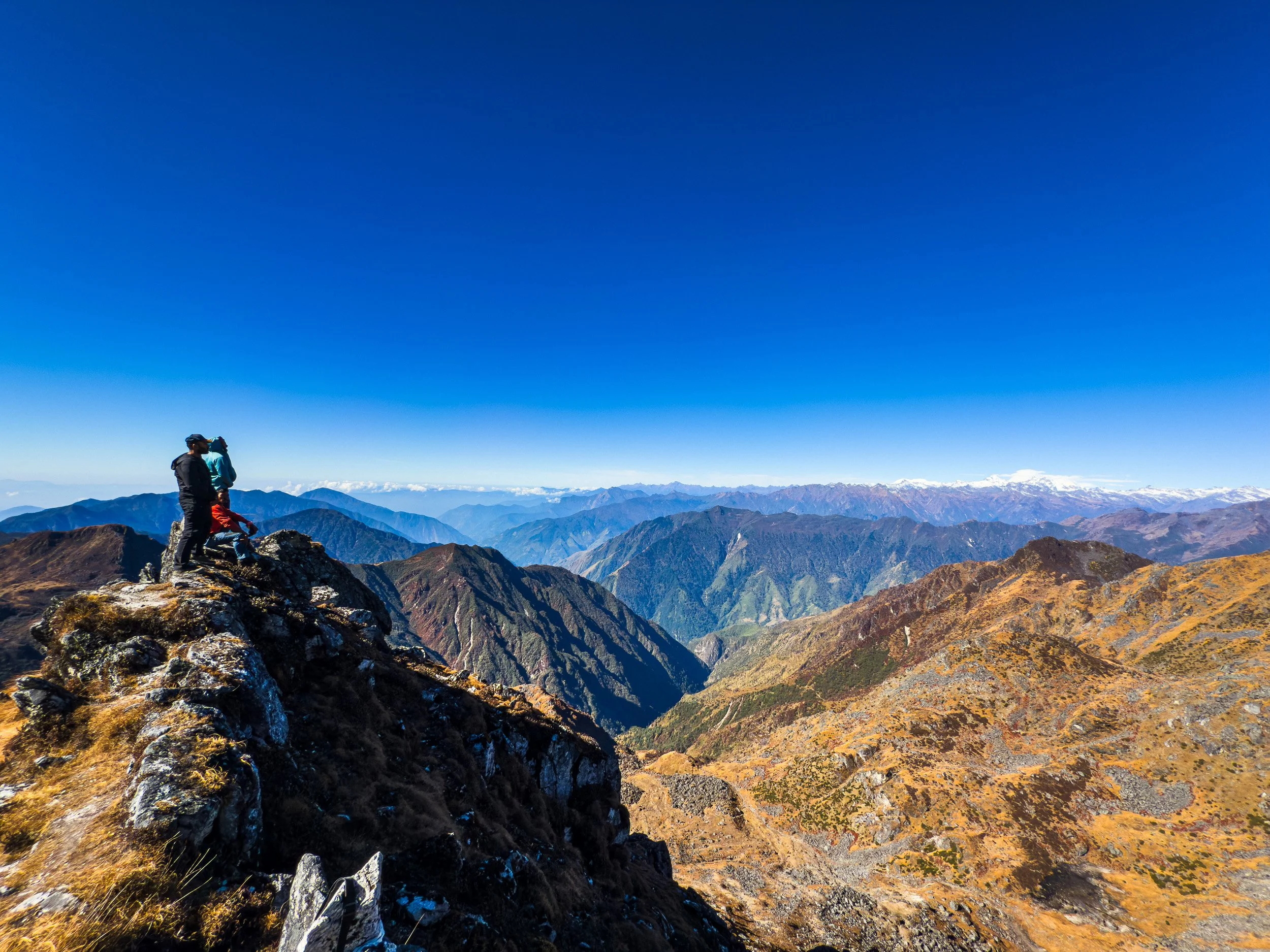
Views from Selele la enroute Kanchenjunga Circuit Trek overlooking Everest and Makalu range on the distant horizon to the west.
If someone were to ask me, what makes this hike different, my first answer would be ‘Lack of Commercialisation’. It is evident that the experience does not feel transactional as we are welcomed by the small family owned teahouses who go above and beyond with their kindness and hospitalty. Over the number of years that I have operated treks in this region, I have been fortunate to witness their kindness and unwavering Himalayan hospitality that I find lacking in other commercial destinations of Nepal. The second would be the lack of crowds. Seeing less than 1000 trekkers every year, we would encounter small number of trekkers on the trail making it a completely serene and tranquil experience. This is truly a perfect journey to experience solitude and serenity.
As someone who has had the opportunity to traverse almost all the trekking destinations of the Himalayas, if somewhere to ask me for recommending a Himalayan journey with the aspirations of peaceful trails, serene and authentic experience and pristine nature, I would wholeheartedly recommend this trek.
Why is Kanchenjunga a Restricted Area?
Kanchenjunga Circuit Trek is a Restricted Area Trek, which means it requires mandatory Restricted Area Permits issued by Immigration Department of Nepal via Trekking Agency. However, with the recent change in regulations, we can acquire permit even for solo trekker as previously there was a minimum requirement of 2 trekkers. In short, Restricted Areas of Nepal are often the border areas in connection with Tibet where its history can be retraced to Tibet-China conflict and its aftermath. With its close proximity and high passes connecting to Tibet and India and the village of Phale where the indigenous community provided their land to settle the Tibetan refugees upon their arrival, Government of Nepal has declared certain regions of Kanchenjunga as Restricted Area.
These high passes are often the sensitive areas of geo-politics and hence, for its effective monitoring of foriegners, the government has imposed the Restricted Area Regions for these high himalyan landscapes. To know more about the Restricted Area Treks in Nepal, you can read this article we have prepared.
A Typical Day on the Kanchenjunga Trek
Kanchenjunga Trek with its remote landscape requires above average endurance. The distance between teahouses and rest-stops are longer and pairing it with rugged trails, it is ideal of experienced hikers and explorers. If you have participated in any of previous multi-day trekking over 14-16 days or thru-hiking, wilderness camping, etc. then Kanchenjunga is the ideal stepping stone towards remote trekking.
Mornings to Afternoon and to Evenings
We wake up usually by 6-6:30 am, have our breakfast by 7 am and aim to hit the trails by 7:30 - 8 am. This fairly early start to the day would help us to cover the rugged trails in a relaxed pace and also allows us to reach the designated lunch villages on time. A later start is feasible but it requires a brisk pace to cover the trails with enough energy to reach the lunch spots and further onto the village where we spend our time. I have designed our itinerary with a healthy composition of short and long days, added acclimatization and dedicated rest days, as we press on this journey.
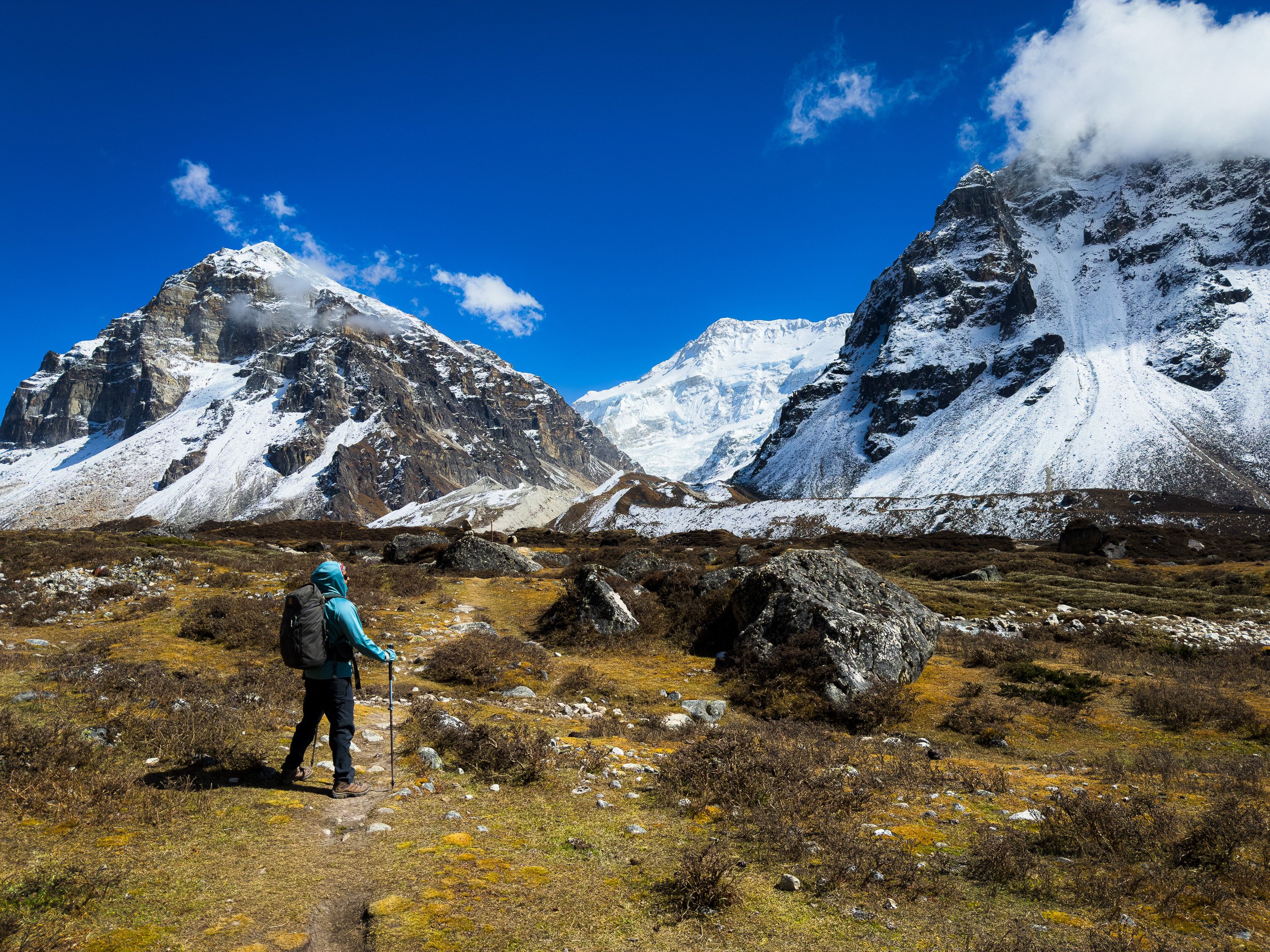
On the way to Lhonak from Khambachhen, ahead is the Mt. Yalung Kang, just ahead of the small teashop that was alledgedly ransacked by the ‘Yeti’
We aim to reach the lunchspot by 12-12:30 pm. Sometimes with the change in the trail conditions, we often taken the longer and safer trails and hence, it would mean we could spend 5-6 hours on the trail before we reach our lunch place. One such example would be when I was leading the trek in Kanchenjunga in Autumn of 2025. The trail from Itahari to Lamatar along the Ghunsa River was swepped away by the monsoon floods and thus, we needed to take the detour of an hour and a half before we reached the village of Amjilosa. Thus, I recommend an early start to the day.
After lunch and a much neede rest of at least 1.5 to 2 hours, we hike for another 3-4 hours, before we make our way to the resting village. We generally aim to reach the night stop by 3-4 pm. This would mean, we would have enough time to rest, recover and freshen up. An early start to the day is crucial for this trek to account for long, rugged trails and to do this in a relaxed pace instead of trying to fit in through the time. There might be days when we would hike for 16-18 kms on this rugged trail, particularly on the day we come back from Lhonak to Ghuna, followed by a dedicated Rest and Recovery Day before we ascend again to Selele High Camp.
Guide Note:
While most companies focus on try to focus on the completion of the trek in the quickest time possible, I recommend the opposite of slowing down this journey. There would be sections of the hike, particuarly day hikes to Pangpema (North Base Camp) and back to Lhonak, crossing 3 Passes (Selele La, Mirgin La and Sine Lapcha La), day hike to Oktang (South Base Camp) from Tseram, thus it is imperative to plan for the combination of shorter days and/or rest days within the itinerary to allow for you to recover and give you all the time to completely soak in the experience rather than blitzing through the trails.
Mountains of Kanchenjunga - Spirituality of Phaktanglung (Mt. Jannu)
Mt. Kanchenjunga is an spiritual entity for the indigenous Sherpa, Limbu, Lepcha and Bhutiya communities. While Lepcha and Bhutiya communities primarily reside in Sikkim (India side) of Kanchenjunga, the mountain herself is known as the Spiritual focal point of the Himalayas. Known as the ‘Five Treasures of the Snow’ signifying Gold, Silver, Gems, Grains and Holy Books/Sacred Texts based atop the five peaks that make up the Kanchenjunga massif.
Other than this, Mt. Jannu or known as Phatanglung for indigenous Limbu communities, it represents the sacred spiritual focal point where the human body transcends to afterlife. For many, this is a reverred spiritual journey to visit Mt. Jannu. There is a large boulder signifiying Mt. Jannu, where the indigenous community leave behind the photographs of their loved ones who has departed in the meaning of showing them the way towards afterlife.
The community believes that, this is the place where their journey began as Hunter Gatherers and eventually, they would reunite with the nature with Phatanglung herself.
Many indigenous communities consider climbing Kanchenjunga and Jannu as disrespectful with Sikkimese government completely banning the expeditions of Mt. Kanchenjunga from their side. Nepal, however, still allows the climbing of both of these majestic peaks and mountaineers (allegedly), never stand atop the true summits of these mountains but rather 20-30 feet below the main summit in order to honor the spiritual sanctity of these mountains.
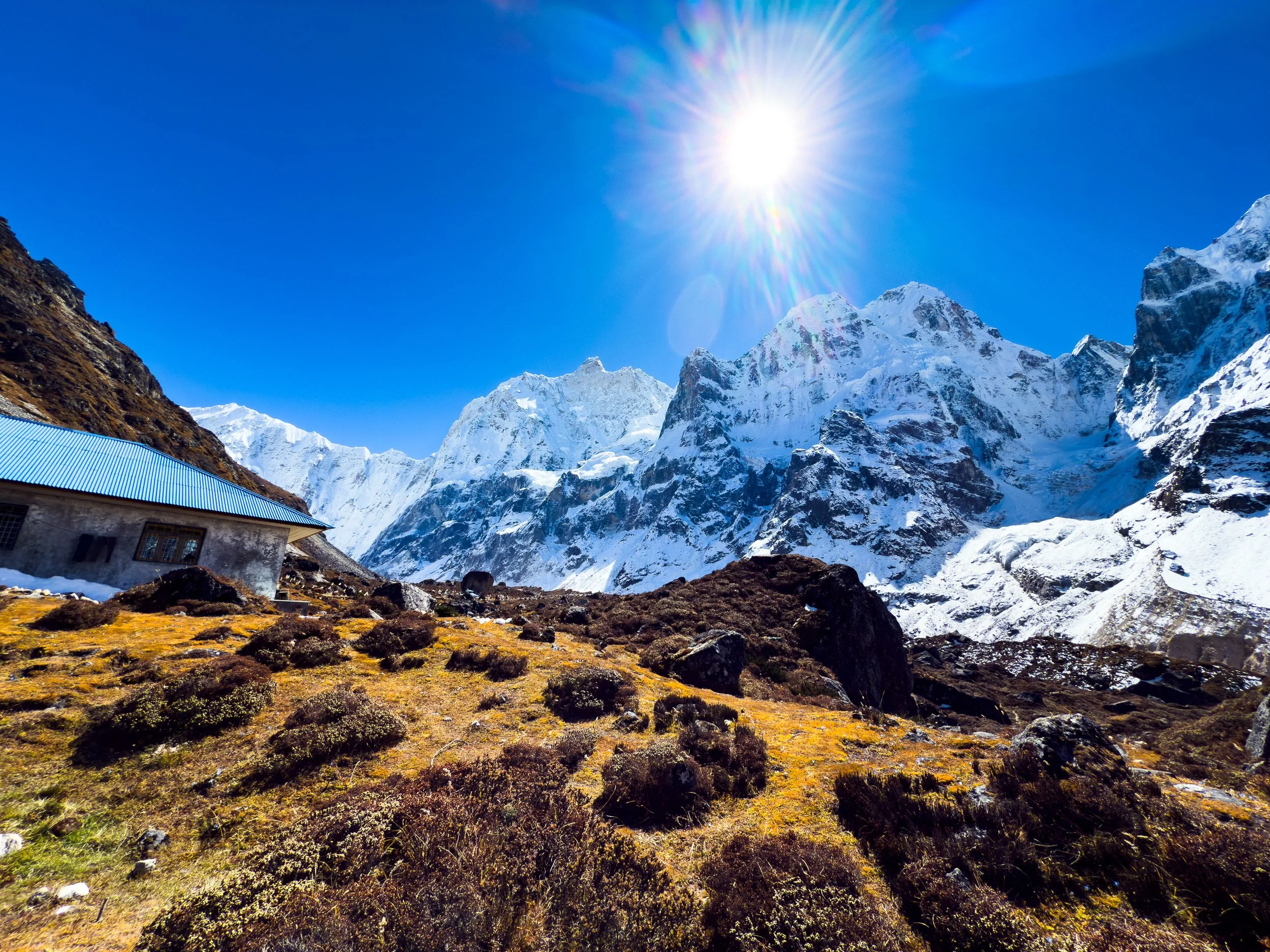
Mt. Jannu, also known as Phaktanglung for the indigenous Limbu coimmunity as seen from Jannu View Point. The small shelter on the left is made for the pilgrims for their journey.
Guide Note:
As much as someone called it placebo, I have always felt a very deep spiritual presence when hiking to Jannu View Point or Phaktanglung. A boulder symbolising the majestic Mt. Phaktanglung, seeing the photos of their departed ones left behind by the pilgrims, the bells and the tridents offered to the spirits, etc. all of this experience make this a deeply spiritual experience combined with the profound landscape amidst the backdrop of Mt. Jannu.
The other mythological story associated with this trek is for Yeti. Allegedly, a small teashop between Khambachhen and Lhonak in a place called Ramche, got ransacked by mysterious animals dumping all their alcoholic produce and eating stored Cooking Oils, Flours, for 2 times in the monsoon of 2024. The owner of the teashop says he has collected the fur that was left behind by the creature whilst breaking into his shop. He refuses to show the evidence though, so this is definitely a story to share when I visit this area. I was there on the Autumn of 2024, when I heard the stories and the locals were definitely saying that it has to be Yeti as this is about 4400m in elevation where Himalayan Black Bears are not present.
For Photography and Flora & Fauna in Kanchenjunga Circuit Trek
As I said before, Kanchenjunga is one of the 34 bio-diversity hotspots of the world. The dense ecology and diversity of this journey gives you the best opportunities to photograph nature at its best and much more so for Researchers and Conservationists studying this majestic eco-system.
Home to 28 species of Rhododendrons out of 32, medicinal herbs like Himalayan Marsh Orchid (Paanch Ooule), Himalayan Giant Rhubarb (Kenjo), etc. and wildlife in the vast landscape from dense subtropical environment to alpine landscape including Himalayan Black Bear, Red Panda and Snowleopards, Kanchenjunga is truly a paradise for someone for wildlife enthusiasts, researchers, academics and/or photographers.
Some of the best photography for the landscape and astrophotoraphy is possible in this region with its lack of light pollution. I cannot imagine the number of nights that I have just witnessed the Milky Way in its grandeur amidst the gorgeous backdrop of the mountains.
Guide Note:
I have been fortunate enough to see Red Panda just for 2 times on the number of years venturing these trails. However, locals do say that the trail between Thangyam to Gyabla with its rich Himalayan Bamboo forestation is one of the key spots to possibly see these elusive creatures. We can make arrangements in the itinerary to spend additional nights - particularly mornings and evenings to try to witness these majestic creatures.
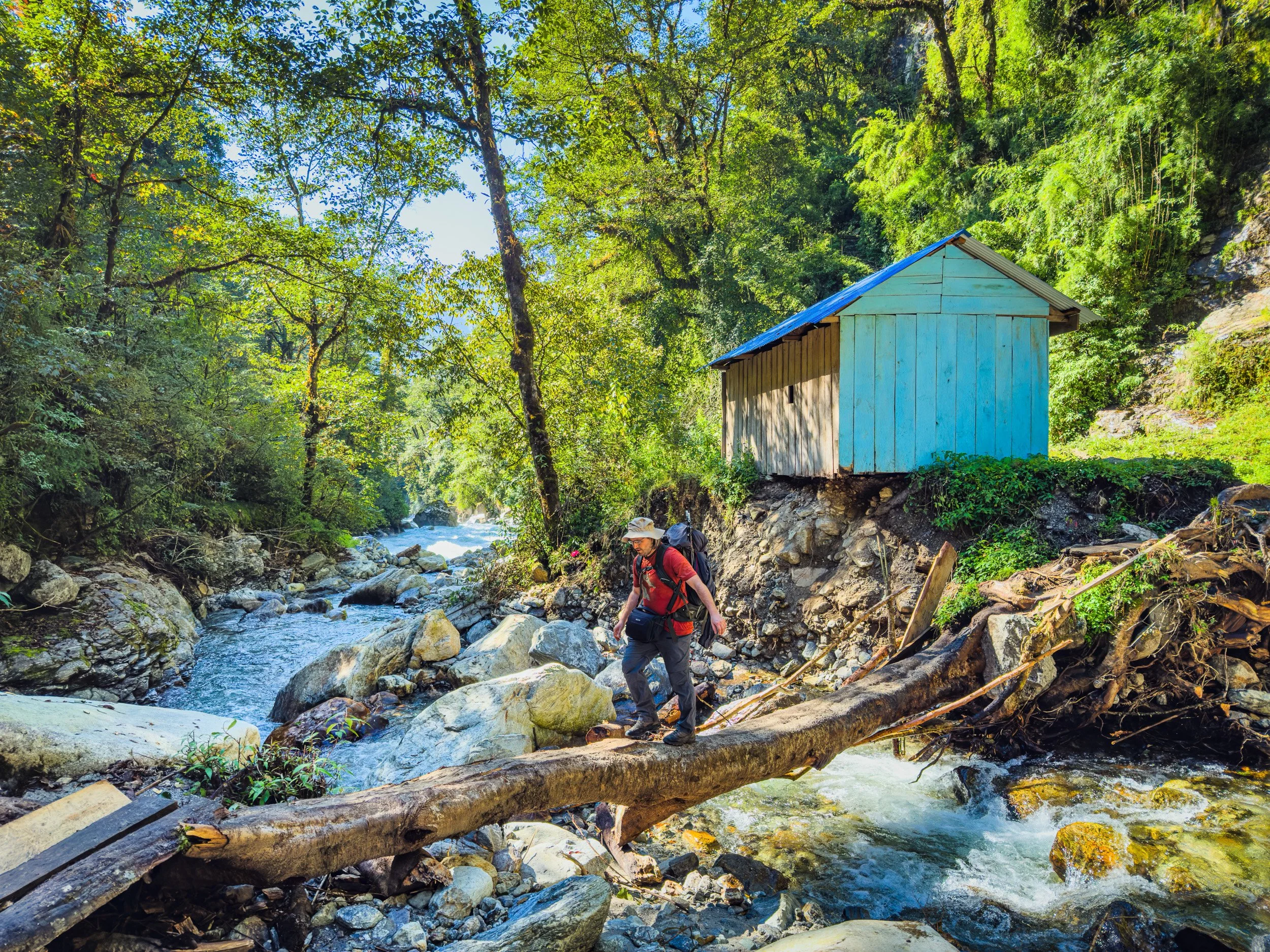
The trail between Thangyam and Gyabla, further ahead is the patch of Himalayan Bamboo forests where there are a lot of reported sightings of Red Pandas by the local villagers.
CONCLUSION
The Kanchenjunga Circuit Trek is far more than a journey to two spectacular base camps—it is an expedition into one of the last truly wild corners of the Himalayas. Its remoteness demands time, preparation, and commitment, but those willing to embrace the challenge are rewarded with an experience that remains remarkably authentic, peaceful, and unforgettable.
If you would like to learn more about the itinerary, permits, trekking seasons, costs, difficulty, or what is included in our guided expeditions, explore our complete Kanchenjunga Circuit Trek page for everything you need to plan your adventure.
FAQs for Kanchenjunga Circuit Trek
-
The Kanchenjunga Circuit Trek is generally not a trek I would recommend for first-time trekkers. While the trail itself does not require technical climbing skills, the combination of prolonged high-altitude exposure, long trekking days, remote logistics, and basic accommodation makes it considerably more demanding than popular trekking routes such as Everest Base Camp or the Annapurna Base Camp Trek.
Ideally, participants should have previous experience on multi-day hikes or high-altitude treks above 3,500–4,000 metres, or possess a strong background in backpacking and endurance-based outdoor activities. More importantly than experience, trekkers should arrive with excellent physical fitness, patience, and the willingness to embrace a more rustic wilderness experience.
If you're unsure whether your experience is suitable, I recommend reading our Kanchenjunga Circuit Trek Difficulty Guide, where we explain the physical requirements, altitude profile, and how to prepare for this remarkable journey.
-
I consider the Kanchenjunga Circuit Trek to be Moderate to Strenuous. The challenge comes less from steep climbing and more from the combination of distance, altitude, remoteness, and the sustained effort required over three weeks.
Trekkers can expect to walk between 6–9 hours on most days while gradually ascending to Pangpema (5,143 m), the highest point of the trek. Several nights are spent above 4,000 metres, where thinner air naturally makes even moderate walking feel more demanding.
The reward, however, is that every challenge contributes to one of the most authentic trekking experiences remaining in Nepal.
For a complete breakdown of the trail, altitude, hiking hours, terrain, and recommended prerequisites, read our detailed Kanchenjunga Circuit Trek Difficulty Guide.
-
Most complete itineraries require 22–24 days, including travel between Kathmandu and the trailhead.
Unlike many trekking regions in Nepal, simply reaching Kanchenjunga is an adventure in itself. The journey includes a domestic flight to Bhadrapur, followed by scenic jeep transfers through Eastern Nepal before arriving at the trailhead in Sekathum.
Because weather, road conditions, and mountain environments are inherently unpredictable, I also recommend allowing an additional 3–4 buffer days in your overall travel plans. These spare days provide flexibility in case of transport delays and allow for a more relaxed trekking experience without feeling rushed.
If you'd like to see a detailed day-by-day itinerary, explore our Complete Kanchenjunga Circuit Trek Itinerary.
-
The two best trekking seasons are Spring (March–May) and Autumn (late September–November).
Spring brings blooming rhododendron forests, pleasant temperatures, longer daylight hours, and excellent opportunities for wildlife photography. Autumn, on the other hand, is known for its crystal-clear mountain views, stable weather, and comfortable trekking conditions after the monsoon has passed.
Each season offers a distinctly different experience, and the best choice ultimately depends on your priorities—whether that's photography, wildflowers, clear panoramas, or avoiding snow.
For a month-by-month breakdown of weather, temperatures, trail conditions, and photography opportunities, read our Best Time to Trek the Kanchenjunga Circuit guide.
-
Yes. Because Kanchenjunga is a remote wilderness region with limited road access and no major medical facilities along the trail, comprehensive travel insurance that includes high-altitude helicopter evacuation is essential.
In the unlikely event of altitude sickness, injury, or medical emergencies, helicopter evacuation is often the fastest and safest method of rescue. Before purchasing a policy, always verify the maximum altitude covered and ensure trekking above 5,000 metres is included.
We strongly recommend arranging insurance before arriving in Nepal so you can focus entirely on enjoying your adventure.
-
Yes.
The Kanchenjunga region is classified as a Restricted Area by the Government of Nepal, making a licensed trekking guide mandatory for all foreign trekkers.
The permit regulations are designed to help preserve the region's fragile environment while ensuring visitor safety in one of Nepal's most remote trekking destinations.
Beyond the legal requirement, an experienced guide greatly enhances the journey through local knowledge, cultural interpretation, logistics, altitude management, and emergency preparedness.
To learn more about permits and regulations, visit our Kanchenjunga Trek Permits Guide.
-
Trekkers require several permits before entering the region, including the Kanchenjunga Restricted Area Permit (RAP)and the Kanchenjunga Conservation Area Permit (KCAP).
Permit arrangements are generally handled by registered trekking agencies, allowing you to focus on preparing for the adventure rather than navigating the application process yourself.
Since permit regulations and associated fees occasionally change, we recommend checking our latest Kanchenjunga Permit Guide for the most up-to-date information.
-
Yes, although the accommodation is considerably more basic than in the Everest or Annapurna regions.
Most villages offer small family-run teahouses providing simple twin rooms, hearty home-cooked meals, warm blankets, and welcoming hospitality. However, trekkers should not expect ensuite bathrooms, luxury facilities, or extensive menus.
One of my favourite aspects of Kanchenjunga is that these teahouses still feel like homes rather than commercial lodges. The warmth and generosity shown by local families remain one of the defining memories for many trekkers.
To see what accommodation, food, charging facilities, hot showers, and internet are available in each village, read our Complete Kanchenjunga Tea House Guide.
-
Connectivity has improved in recent years, although the experience remains far removed from everyday life. There is 4G connectivity available in Ghunsa recently, however, the reliability of this new connection is still on test.
Mobile coverage is available in some villages but becomes increasingly limited as you gain altitude. Several settlements, including Ghunsa, Khambachen, and Lhonak, now offer Starlink internet, usually for a small daily fee, although speeds and reliability depend on weather and local demand.
Rather than seeing the lack of connectivity as an inconvenience, many trekkers find it one of the most rewarding aspects of the journey—a rare opportunity to disconnect from screens and reconnect with nature.
For the latest updates on coverage, charging facilities, and Starlink availability, visit our Internet & Connectivity on the Kanchenjunga Circuit guide.
-
Absolutely. One of the advantages of travelling with Darchog Adventures is the flexibility to tailor the itinerary to your interests and pace. If your goal is to spend more time photographing landscapes, wildlife, or local culture, we can incorporate additional acclimatisation or exploration days at key locations such as Ghunsa, Khambachen, or Pangpema (Kanchenjunga North Base Camp), depending on the itinerary and prevailing conditions.
Many photographers appreciate the opportunity to wait for changing light, favourable weather, or wildlife activity rather than feeling pressured to follow a fixed schedule. Likewise, trekkers who simply wish to immerse themselves in the region often enjoy adding rest days to explore surrounding valleys, interact with local communities, or experience the mountains at a slower pace.
Since Kanchenjunga is one of Nepal's most remote trekking regions, itinerary adjustments require careful planning around permits, logistics, and transportation. We are happy to help design a customised itinerary that matches your interests, fitness level, and available time while maintaining a safe and enjoyable pace throughout the journey.
Still have questions?
The Kanchenjunga Circuit Trek is one of Nepal's most remote and rewarding adventures, and it's natural to have questions while planning your journey. If you're looking for more detailed information, explore our complete Kanchenjunga Circuit Trek page, where you'll find everything from the itinerary and permits to costs, preparation, and practical travel advice.
To learn more about our approach to guiding, our commitment to ethical trekking, and what makes travelling with Darchog Adventures different, visit our Why Trek with Darchog Adventures page.
If you can't find the answer you're looking for, feel free to get in touch. We'd be delighted to help you plan an adventure that matches your experience, interests, and aspirations.
